Colin D Sumrall
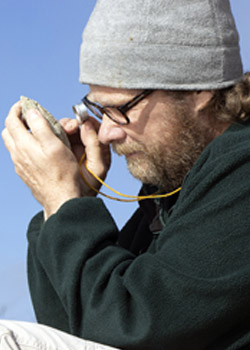
Colin D Sumrall
Colin Sumrall’s research is centered on understanding the paleobiology of extinct echinoderms (starfish and their allies). My research tends to be phylogenetically oriented and echinoderms lend themselves to a phylogenetic approach because their intricate morphology, coupled with a high degree of morphological disparity, allow for the coding of robust datasets for phylogenetic analysis. At present I am focusing on three fundamental questions: What is the nature of the Cambrian-Ordovician explosive radiation of echinoderm body plans? How can phylogeny and development be used to answer paleontological questions? Fossil life incorporated into rocks of the Earth’s crust is one strongest tools for understanding the evolution of the Earth System. To best interpret how life has changed through time, it is critical to place organisms into an evolutionary framework. Dr. Sumrall has been investigating the evolutionary history of echinoderms (relatives of starfish and sand dollars) to determine the causes of origination and diversification of major taxonomic groups. Much of this research centers on the identification of like parts in different organisms (homology) that is used to analyze evolutionary relationships. How is the collection of fossils and consequently our understanding of the fossil record biased by geography, time, and facies?
Contact
Phone: 865-974-0400
Email: csumrall@utk.edu
Research Interests
I use field investigations, phylogenetic methods and morphological analysis to understand the timing, nature and ecology of echinoderm evolution and the origin of modern taxa.