Colin D Sumrall
Scrap
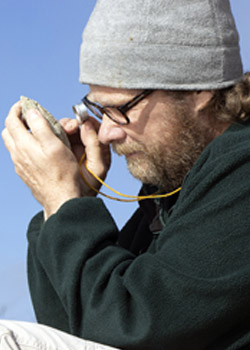
Colin D. Sumrall

Colin Sumrall’s research is centered on understanding the paleobiology of extinct echinoderms (starfish and their allies). My research tends to be phylogenetically oriented and echinoderms lend themselves to a phylogenetic approach because their intricate morphology, coupled with a high degree of morphological disparity, allow for the coding of robust datasets for phylogenetic analysis.
At present I am focusing on three fundamental questions:
- What is the nature of the Cambrian-Ordovician explosive radiation of echinoderm body plans?
- How can phylogeny and development be used to answer paleontological questions?
Fossil life incorporated into rocks of the Earth’s crust is one strongest tools for understanding the evolution of the Earth System. To best interpret how life has changed through time, it is critical to place organisms into an evolutionary framework. Dr. Sumrall has been investigating the evolutionary history of echinoderms (relatives of starfish and sand dollars) to determine the causes of origination and diversification of major taxonomic groups. Much of this research centers on the identification of like parts in different organisms (homology) that is used to analyze evolutionary relationships.
- How is the collection of fossils and consequently our understanding of the fossil record biased by geography, time, and facies?
Publications
Recent publications
- Sumrall, C.D. 2017. New insights concerning homology of the oral area and ambulacral system in echinoderms. In, S. Zamora (ed.) Progress in Echinoderm Paleontology, Special issue of Journal of Paleontology. 91 (4), 604-617.
- Sheffield, S.A. and C.D. Sumrall. 2017. Generic revision of the Holocystites Fauna of North America (Diploporita: Echinodermata) based on universal elemental homology. In, S. Zamora (ed.) Progress in Echinoderm Paleontology, Special issue of Journal of Paleontology. 91 (4), 755-766.
- Bauer, J.E., C.D. Sumrall, and J.A. Waters. 2017. Hydrospire morphology and its implications for blastoid phylogenetic inference. In, S. Zamora (ed.) Progress in Echinoderm Paleontology, Special issue of Journal of Paleontology. 91 (4), 847-857.
- Waters, J.A., L.E. White, C.D. Sumrall, and B.K. Nguyen. 2017. A new model of respiration in blastoid (Echinodermata) hydrospires based CFD simulations of virtual 3D models. In, S. Zamora (ed.) Progress in Echinoderm Paleontology, Special issue of Journal of Paleontology. 91 (4), 662-671.
- Sheffield, S.A., W.I. Ausich and C.D. Sumrall. 2018. Late Ordovician (Hirnantian) diploporitan fauna of Anticosti Island, Quebec, Canada: implications for evolutionary and biogeographic patterns. Canadian Journal of Earth Sciences. 55(1), 1-7.
- Zamora, S. and C.D. Sumrall. 2018. First report of coronates (Echinodermata) from Africa. In Hunter, A. (ed.) The Upper Ordovician Echinoderm Fauna from the Anti-Atlas Mountains of Morocco, Special Papers in Palaeontology. V. 485.
- Sumrall, C.D. and S. Zamora. 2018. New data on edrioasteroids from the Upper Ordovician of the Anti-Atlas (Morocco). In Hunter, A. (ed.) The Upper Ordovician Echinoderm Fauna from the Anti-Atlas Mountains of Morocco, Special Papers in Palaeontology. V. 485.
- Sheffield, S.L and C.D. Sumrall. 2019. A re-interpretation of the ambulacral system of Eumorphocystis (Blastozoa: Echinodermata) and its bearing on the evolution of early crinoids. Palaeontology. 62(1), 163-173.
- Shroat-Lewis, R.A., E. Greenwood and C.D. Sumrall. 2019. Paleoecologic analysis of edrioasteroid (Echinodermata) encrusted slabs from the Chesterian (Upper Mississippian) Kinkaid Limestone of southern Illinois, PAILOS. 34(3), 146-158.
- Bauer, J.E., J.A. Waters and C.D. Sumrall. 2019. Reevaluation of Macurdablastus with implications for the origins of Eublastoidea. Palaeontology. 62(6), 1003-1013.
- Zamora, S. and C.D. Sumrall. 2019. Hexedriocystis, an aberrant eocrinoid convergent with edrioasteroids from the Upper Ordovician of Morocco. In Hunter, A. (ed.) The Upper Ordovician Echinoderm Fauna from the Anti-Atlas Mountains of Morocco, Special Papers in Palaeontology. V. 485.
- Sheffield, S.L. and C.D. Sumrall. 2019. The phylogeny of the Diploporita: a polyphyletic assemblage of blastozoan echinoderms. Journal of Paleontology, 93(4):740-752.
- Carerra, M. and C.D. Sumrall. 2019. Ordovician Sponges from the Lenoir Limestone, Tennessee: New evidence for a differential sponge distribution along the Laurentian Margin, Journal of Paleontology. 94(1), 34-44.
- Paton, T., R. Freeman, B. Datillo, C.E. Brett, and C.D. Sumrall. 2019. Taphonomic feedback of an edrioasteroid-encrusted coral graveyard from the upper Ordovician (Cincinnatian, Richmondian) of central Kentucky. Palaeogeography, Palaeoclimatology, Palaeoecology. 537(2020), 109447.
- Zamora, S., D. Wright, R. Mooi, B. Lefebvre, T.E. Guensburg, P. Gorzelak, B. David, L. Cole, C.D. Sumrall, Aaron Hunter, J. Sprinkle, J. Thompson, T. Ewin, O. Fatka, E. Nardin, M. Reich, M. Nohejlová, and I.A. Rahman.. 2020. Re-evaluating the phylogenetic position of the enigmatic early Cambrian deuterostome Yanjiahella. Nature Communications. 11(1286).
- Deline, B., J.R. Thompson, N.S. Smith, S. Zamora, I.A. Rahman, S.L. Sheffield, W.I. Ausich, T.W. Kammer, and C.D. Sumrall. 2020. Evolution and development at the origin of a phylum. Current biology. 30(9), 1672-1679.
- Zamora, S., J. Sprinkle, and C.D. Sumrall. 2020. A revaluation of Rhipidocystidae based on a new flattened eocrinoid (Blastozoa, Echinodermata) from the Upper Ordovician of Maryland (USA). Acta Paleontologica Polonica. 65(3), 455-465.
- Brochu, C.A. and C.D. Sumrall. 2020. Modern cryptic species and crocodylian diversity in the fossil record. Zoological Journal of the Linnean Society. 198(2), 700-711.
Sumrall, C.D. and D. Phelps. 2020. Spiracarneyella a new carneyellid edrioasteroid from the Upper Ordovician (Katian) of Kentucky and Ohio and comments on carneyellid heterochrony. Journal of Paleontology. - Sumrall, C.D. 2020. Pan-Echinodermata. p. 641-644, Echinodermata. p. 645-648, Edrioasterida. p. 649-650, Isorophida. p. 651-652, Isorophina. p. 653-654, Agelacrinitidae. p. 655-656, Lepidodiscina. p. 657-658, and Discocystinae. p. 659-660. In K. de Queiroz, J. Gauthier, and P. Cantino (eds.) Phylonyms: A Companion Volume to the PhyloCode. Taylor & Francis Group, London. (This peer-reviewed edited volume is the official document that replaces the 250 year-old Linnaean Classification of life with the PhyloCode tree based classification.)
Contact
Phone: 865-974-0400
Email: csumrall@utk.edu
Research Interests
I use field investigations, phylogenetic methods and morphological analysis to understand the timing, nature and ecology of echinoderm evolution and the origin of modern taxa.
Education
- Ph.D. (1996) University of Texas at Austin (Dr. James Sprinkle, advisor)
- M.A. (1991) University of Texas at Austin (Dr. James Sprinkle, advisor)
- B.S. (1989) Arizona State University, magna cum laude (Dr. Robert Lundin, advisor)