From Curiosity to Purpose

From Curiosity to Purpose
Fieldwork, undergraduate research, and internships have prepared Marius Charles for a career in environmental consulting.
Learning that the Earth was spherical and made of layers changed how Marius Charles saw the world when he was in seventh grade. Majoring in geology and environmental studies at the University of Tennessee, Knoxville, showed Charles how he could apply his studies to protect the environment.
“My goal is to build a lasting career in environmental consulting, with a focus on groundwater and sustainable land use, ideally right here in the Southeastern United States,” said Charles, a member of the Class of 2026.
“The earth, environmental, and planetary sciences department has given me opportunities I never imagined, from conducting research to traveling across the country for field camp,” he said.
“UT has given me the tools to turn curiosity into impact,” Charles said. “Through research, internships, and fieldwork, I’ve built a strong foundation for graduate school and job readiness
I’ve learned how to ask meaningful questions, design defensible workflows, and apply technical skills to real-world problems.”
Transformative Learning
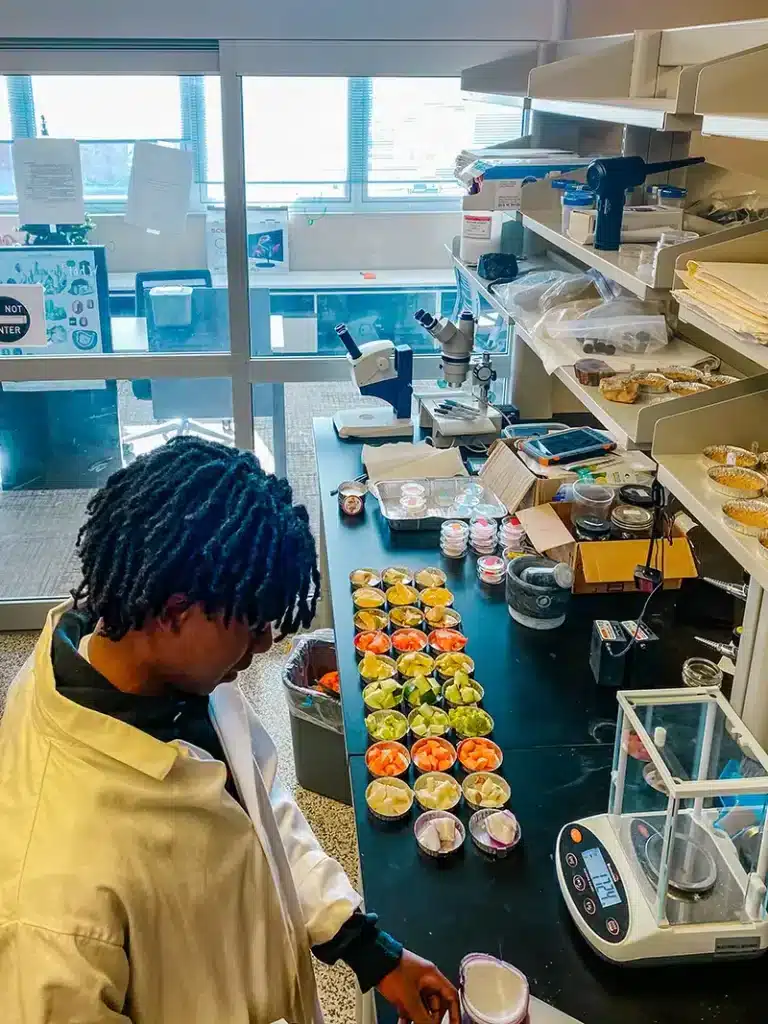
The Introduction to Scientific Field Methods and Analyses course allowed Charles to work in the field and the lab.
“We spent a semester researching and presenting findings on metal pollution in Knoxville’s Third and Second creeks, and that experience showed me how satisfying and worthwhile environmental work can be,” he said. “It pushed me to take Principles of Hydrogeology, even though I’m a straight geology concentration major.”
Charles also calls his two summer internships with CDM Smith—an engineering and construction firm focused on solving environmental and infrastructure challenges—transformative.
“Working with groundwater wells, subsurface analysis, and hydrogeological sampling showed me how geology could directly support environmental monitoring, engineering projects, and public health,” he said. “I installed monitoring wells, analyzed VOCs (volatile organic compounds), collaborated on EPA (Environmental Protection Agency) remediation projects, and prepared environmental reports.”
“These experiences challenged me, helped me connect with peers, and shaped the technical skills I now bring to every research project,” he said.
Support and Encouragement
With encouragement from Professor Michael McKinney, Charles presented their fall 2024 microplastics study at the Tennessee Academy of Science, as well as the UT Success Academy and at a 1794 Honors event.
“That study looked at microplastic contamination across groundwater, pond water, precipitation, soil, and atmospheric deposition in semi-urban farmland,” Charles explained. “It laid the foundation for my current research on microplastics in fruits and vegetables, where I’m investigating internal fiber uptake through xylem transport.”
“Building on our environmental media study helped me refine my methodology and connect field data to food safety and human exposure,” he said.
When Charles arrived at UT, he found a campus that was welcoming and energizing, and in EEPS he found support throughout his undergraduate experience.
“They funded all costs related to my research, including materials and travel for presentations,” he said. “They also funded my field camp, which took me to Nevada, Arizona, and California to study geological and hydrological systems, groundwater flow, and climate impacts. That trip was one of the most formative experiences of my undergraduate studies.”